Voidbeast
New Life as a Max Level ArchmageVoidbeasts are otherworldly predators that emerge from the dimensional breach and turn a localized disaster into a threat capable of destroying cities and continents. Their defining significance lies in the combination of immense physical durability, resistance to magic and System-granted abilities, and an apparent hierarchy in which size closely tracks strength. They are not merely monsters to be defeated; they are intrusions from an alien environment whose biology challenges the assumptions on which the world’s magical and martial systems depend.
Classification and Scale
The Grand System distinguishes at least three levels of Voidbeast. A Lesser Voidbeast is recorded at level 1340, an ordinary Voidbeast at level 1423, and a Greater Voidbeast at level 1702. The distinctions are not academic: most of the population cannot approach such creatures, and even Titled adventurers can only reliably confront the Lesser variety. The stronger specimens are threats that can tear open guildhalls and kill the most powerful Titled adventurers with a single attack.
The scale of the outbreak makes the hierarchy especially consequential. Voidlings, the weaker members of the invading horde, are generally estimated to be below Titled rank and can theoretically be contained by sufficient numbers of mithril- and orichalcum-rank adventurers working together. The Voidbeasts are different. Dozens or hundreds of creatures exceed level 1700, making them the targets that require the attention of the strongest combatants rather than ordinary crowd-control measures. The largest known specimen reaches level 1950, a figure that places it beside the third-strongest Cataclysm and suggests the power to ruin entire continents.
Physical Nature and Magical Resistance
Voidbeasts possess bodies that are both physically formidable and unusually difficult to affect through supernatural means. Vivisari Vexaria understands them as fauna from another world or environment, creatures whose bodies have evolved to be tough, sharp, and resistant to every form of magic she has encountered, including skills and statistics bestowed by the Grand System. Their glassy black armor is not simply thick skin: it interferes with the mechanisms by which the world’s inhabitants ordinarily impose power upon matter.
Vivisari Vexaria compares their bodies to those of deep-sea creatures. Their sleek, hydrodynamic forms seem built to move through an alien medium with minimal resistance, yet her own advantage lies in changing the conditions around them by thickening the medium and introducing obstacles. The comparison becomes grotesque when applied to the largest specimen: the creature is not a small, refined object like the transparent black-and-violet dagger carried by the assassin, but an alien worm-dragon nearly three hundred feet long and as thick as a building. That contrast defines the practical challenge of fighting it. A material that can resist ordinary magic may still be vulnerable to sufficiently sophisticated manipulation, but scale turns the problem into one of endurance as well as technique.
The limits of conventional power are visible even in divine-infused magic. The Archbishop’s golden column of fire strikes a level-1430 Voidbeast and burns deeply into its armor without penetrating far enough to kill it. The wound is itself remarkable, since Vivisari Vexaria has seen no one else kill a Voidbeast, much less a Greater Voidbeast, but the result confirms that sacred power is not an automatic answer to the invasion. Against these creatures, divine, arcane, and System-mediated abilities all face the same fundamental resistance.
Emergence from the Dimensional Breach
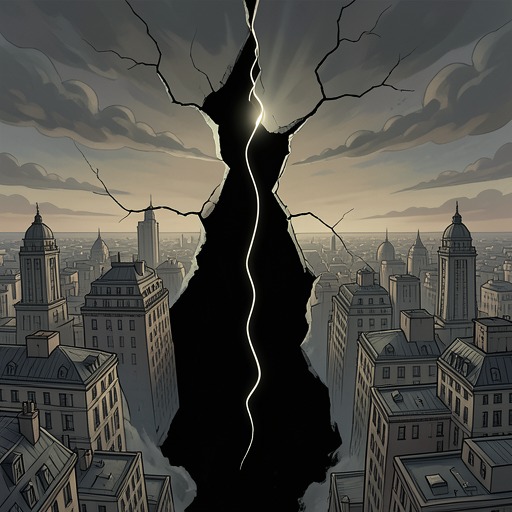
The Voidbeasts enter the world through the abyss created when the Wardens’ guildhall and the land beneath it sink into a supernatural void. The opening is not a normal crater or portal. It descends through broken dimensional shards into infinite darkness and exposes a wound leading to the Other Side, a realm that neither Vivisari Vexaria nor anyone else should have been able to see. The monsters therefore embody a violation of spatial and metaphysical boundaries: their arrival is the living consequence of a boundary being punctured.
The creatures emerge in shoulder-to-shoulder waves, with the weaker Voidlings and larger Voidbeasts continually flooding out of the hole. Their passage is interrupted only when an exceptionally large Greater Voidbeast breaches the opening. Its smooth, eyeless head appears first, followed by a long, cylindrical, segmented body that rises into the air without wings and moves in sinuous motions. Because the monster is nearly as thick as the pit itself, it blocks the flow of every other creature for the several seconds required to enter the world. Size thus functions both as a sign of rank and as a physical mechanism shaping the invasion.
The spectacle produces a graduated horror. At first, the breach reveals an unfamiliar threat whose origins remain beyond ordinary knowledge. Then the System supplies approximate names and levels, turning dread into measurable danger without making it manageable. Finally, the largest creature becomes visible as a body of impossible scale, while the wound behind it continues to open onto an unknowable realm. The threat is both classified and not understood: numerical information offers a foothold, but the creatures’ origin and biology remain fundamentally alien.
The Outbreak and Vivisari Vexaria’s Response
The invasion occurs in the center of the Adventurer’s District, close to the city’s strongest guilds. Alarm bells begin ringing almost immediately, drawing adventurers into the streets, including some who arrive without armor or equipment. Their courage becomes part of the danger, because the district fills with people eager to respond before they understand what they are facing. The weaker creatures can be addressed through coordinated numbers, but the Greater Voidbeasts create gaps in the city’s defenses that ordinary heroism cannot close.
Vivisari Vexaria first uses Inspection and receives approximate readings rather than full identifications. Her own level is shown as 980, while the monsters register at levels 1340, 1423, 1702, and eventually 1950. The disparity is large enough to make her position seem vulnerable, even though her capabilities exceed what the numerical comparison alone suggests. The readings also establish that the Grand System is treating the creatures as genuine, quantifiable entities rather than presenting an error or illusion.
The largest Greater Voidbeast emerges just as Vivisari Vexaria is preparing to leave Rafael with instructions to determine what can be learned about the situation. She recognizes that dealing with it will require effort, but she also welcomes the confrontation as a physical outlet for the frustration and worry accumulated after her meeting with Duke Caldimore and Saffra’s nighttime arrival at her door. Her comfort with this kind of crisis contrasts sharply with her uncertainty about political and interpersonal conflict. She does not know how to manage a potentially insane duke, but destroying a city-erasing monster from beyond the dimensional veil is a problem she knows how to approach.
Vivisari Vexaria’s method changes during the battle. She combines the practical experience gained fighting the Red Tithe with her understanding of the material from which the creatures originate, adapting her spells to overcome their resistance. She destroys four of the largest threats, each one becoming easier as she refines her approach, although every victory consumes substantial mana. She cannot continue indefinitely, even with potions, and the continuing flow of creatures makes the tactical problem a race against exhaustion. The battle therefore advances her magical understanding while simultaneously exposing the cost of relying on individual power.
Consequences and Narrative Significance
The outbreak produces casualties almost immediately. Vivisari Vexaria can eliminate many weaker Voidlings without specially adapted abilities, but the disaster is unlike the earlier Convoy assault, where a single spell could erase a horde at her discretion. Only Greater Telekinesis has been adapted for this form of combat, and revising the rest of her grimoire would take too long while people die each second. The presence of weaker creatures that can be contained and stronger ones that can kill Titled adventurers creates a crisis that cannot be solved by a single uniform response.
The Voidbeasts also reveal a structural vulnerability in the world. The Wardens’ guildhall is not merely damaged; it vanishes along with the land beneath it, leaving a pit of dimensional fragments and an open wound into the Other Side. The monsters are consequently inseparable from the consequences of careless contact with the boundary between worlds. Their bodies make contamination visible: alien matter crosses into the familiar world, while the breach threatens to draw the familiar world outward into something unknown.
Their appearance shifts the narrative from ordinary magical escalation to a confrontation with the limits of categorization, defense, and human agency. Levels can indicate magnitude, but they do not explain origin. Guild ranks can organize a response, but they cannot protect adventurers from creatures above the reach of the Titled. Sacred fire can injure a Voidbeast, yet cannot guarantee victory. Vivisari Vexaria’s successes establish her as the only combatant presently able to adapt fast enough to challenge the strongest specimens, while the continuing emergence of monsters shows that even her victories are temporary until the breach itself is closed. Voidbeasts therefore function as both antagonistic creatures and symptoms of a deeper dimensional catastrophe: killing them matters, but solving the invasion requires reaching its source.